1.9.23

Ean, the stray with an injured paw

Would you believe that there are happy strays? 

Contrary to popular belief, not all strays want a home, want to be rescued or are unhappy where they are. There are relatively happy strays who have the freedom to play, run around with their friends, are sterilized (so they don't constantly get mated on) and have a regular food source and feeders who check in on their well-being from time to time. Despite being exposed to the elements and going hungry and thirsty at times, some strays seem better-off not being a domestic pet and having the liberty to run around as they pleased. 

Although Ean was found with injuries, he isn't a typical miserable stray, like some that we have come across. When an elderly aunty feeder told us about him, we went down to search for him immediately but was unable to locate him. Then another group of feeders went down again in the evening with SOSD's Trap-Neuter-Rescue team and found him resting in a vacated building. Ean seem almost relieved that help had come for him and went into the carrier without much of a struggle. We guessed part of him instinctively knew he needed urgent medical aid. Smart boy! 

 
Ean hiding in the vacated building


Blood on floor of vacated building


At the clinic, because of the extent of his paw injury, he had to be sedated for the vet to assess his condition. His entire paw was maggot infested, there is an awful open wound with a lot of infected and dying tissue – the vet reckoned it's been about a week since his injury. In fact, its so badly infected that his leg is swollen right up to his knee. Imagine the amount of agony he has been through the entire week. Poor sweet boy. The vet estimated that he is a relatively young dog, maybe 5 to 6 yrs old as his teeth are in moderately good shape and he seems to have been sterilized. 

He came from the vicinity of Hay Dairies, which has deep forestation, so it came as no surprise that he has heartworm and also baby worms – We requested treatment for this to be started immediately. X-Ray scans on his left hind paw shows some broken bones and dislocation. Unfortunately all of his toe bones are dislocated and 1 of them is also shattered. 


The vet believes that something heavy might have fallen on his paw and in his haste and shock to get away, he might have injured it further. It is unlikely that a vehicle have rolled over his back paw because then he would have other injuries. Based on the severity of his injuries, it is most likely that his entire leg will be amputated because it likely will never heal and he won't be able to bear weight on it. Next week he is scheduled for a heart ultrasound to see how bad his heartworm is – and with the results we will then make a decision to him to go for surgery and proceed to amputate his hind leg. In the meantime, all maggots have been removed from his paw and wrapped up with disinfectant medications. The nurses will sedate him and clean his wound daily to prevent him from going through more pain. It looks like we are in a for a long haul and Ean is expected to stay at the vet for some weeks to fully recuperate from his awful injuries. 


Ean is a very handsome dog, with puppy eyes still and tilts his head curiously at the new environment and people around him. He is also slightly wary but not as skittish is most newly rescued strays. We think he'll start trusting us soon and let us pat him. However this poor little boy is also not eating, perhaps due to his surroundings that are foreign to him and maybe he do not understand why he is there. We hope it's just a simple case of him not being used to such bland hospital food. ☹ 


We need your help and support to see Ean (pronounced Ian) through this difficult time. He has been so brave and its fate and a stroke of luck that we've managed to catch him for medical treatment. The alternative would have been too distressing to imagine.

Email hopedogrescue@singnet.com.sg if you are able to cheer Ean on for the days ahead with us. Given the extent of his injuries, the vet bills are going to be hefty. We are grateful for any help that you can give. Thank you!

27.7.23

Minnie (Low Income Family)

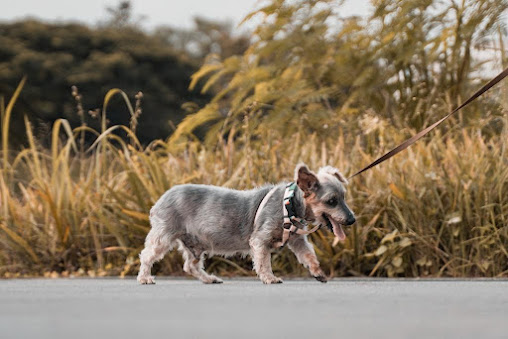
Minnie - the senior poodle from a low income family.

HOPE has been helping Minnie with her vet bills for the past 3 months after her owner contacted us. Minnie had been unwell for a while, but could not afford to go to a vet as her owner was out of a regular job. Her owner didn't want to give Minnie up, and was at a loss. Then, someone told her that HOPE could help Minnie, without taking away her dog or insisting on rehoming.


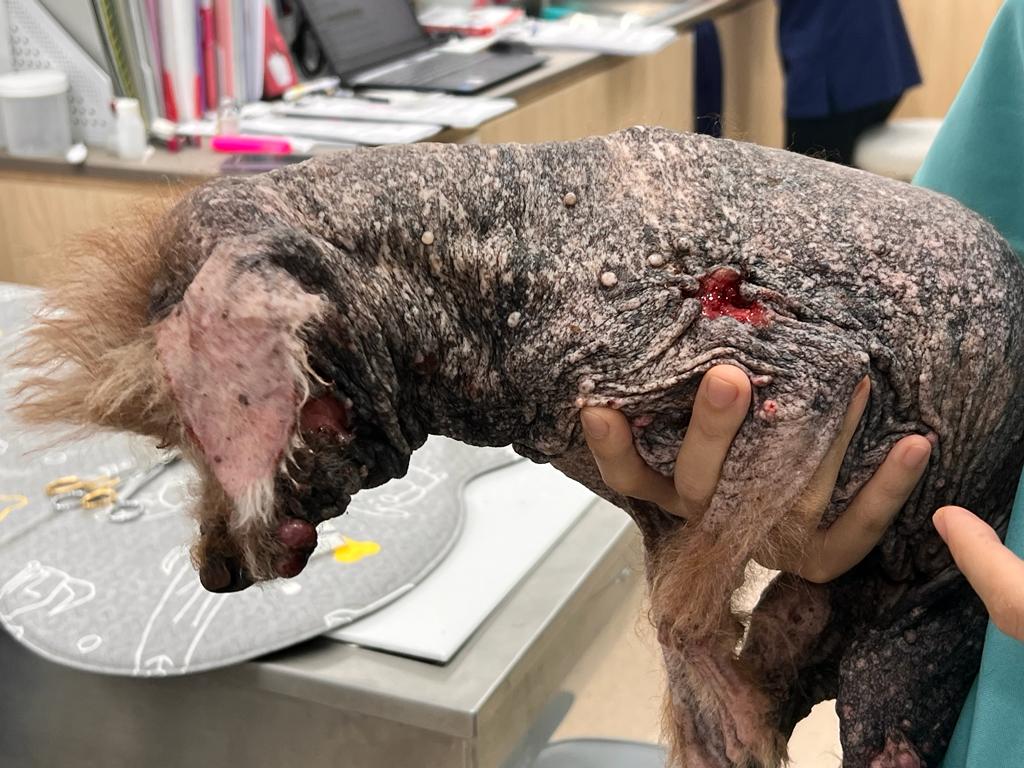
Minnie is 14. She has ringworms and many open sores on her body, mouth, and ears. The vet told us it is most probable that Minnie has skin cancer, considering that her sores were bleeding and are not healing well. We did not do a biopsy because her skin was poor, and healing would have been an issue after removing a small sample of her skin.

Poor Minnie smells really bad due to the huge tumour in her ear coupled with constant bleeding on the skin - so bad that it leaves a foul odour behind. The vet gave her fentanyl patch (morphine) for pain management, but Minnie did not take well to it after a day. She whined and didn't eat well, so we removed the patch and revisited the vet a day later. Oral pain meds were prescribed this time. 

Throughout her ordeal, Minnie was really sweet and obliging, despite all her pain.


Unfortunately, although her skin fungal issues has improved, her cancer has spread. She also has to deal with joint pain from arthritis and spinal issues. Her owner shared that these days, the pain limits her in her movements. No longer is she the high energy sociable dog who would rush to play with other dogs.


For now, the main objective is to keep her comfortable and pain free.

Minnie's recent vet bill costs $1157 after two vet visits. If you can help Minnie, please email hopedogrescue@singnet.com.sg. Any help is appreciated.

5.6.23

Our Rescues - They Need You

Since HOPE Dog Rescue first started in 2011, we have had many furiends come through our doors. Well, not literally, because as most of you may know, HOPE does not have a physical shelter and we rely mainly on fosters and boarding places. Before you read on, can you guess how many rescues are currently under our care now? 😛

Did you get it right? Yes, we have a grand total of 6 dogs and 1 cat under our care now, all of whom are senior citizens and/or with special needs. How well do you know them? Introducing them one by one again, starting from the most senior one. 🥰


Chloe: Affectionately known as grandma Chloe, she is a 17-year-old shih tzu surrendered by her owner. Despite being blind and deaf, she's still eating and sleeping well and enjoying life to the fullest.  Read her story

Grandma Chloe aka Piglet

Banjo: We referred to him as the skeletal dog when he was surrendered to us because that was exactly how he looked. He was in a very sad and neglected state but has since blossomed so much. He's 16 years old and looking for a home to spend his golden years. This is his story

Prince Banjo

Olive: This 11-year-old female shih tzu is the only one under our care now who is battling cancer. ☹️ She recently had a lump removal surgery and is overall doing well now. This is the best possible outcome we can ask for this little chilli padi with a big personality!  Her story

Olive aka Chilli Padi

Holly: The camp dog who made quite a headline--her skin was in a very bad state when we managed to secure and rescue her. She can be rather skittish as with other street dogs but it's hard to blame her if she was living in the wild alone all these world. She is a Singapore Special, estimated to be 10 years old. Read her story

Holly


Winter: A breeding farm survivor. Despite her numerous health complications, her independent, calm, and sweet nature endears her to everyone she meets. 


Winter


Inky: Our most recent rescue, who was in such a terrifying state when we found him. Left with only one eye and a fractured jaw, he is still on a long and difficult journey of recovery. He has to be tube fed four times a day now but with your support, we are doing all we can to help him. His rescue story

Inky

At HOPE, we try as much as we can to support senior dogs of low-income senior citizens, in terms of food and vet bills, as well. If you have been following us, you would have read occasionally about Oreo (Aunty Huang's 12-year-old senior dog with ear and eye issues), Taco (Mr Akira's 10-year-old beagle whom we have supported for seven years) and Minnie (14-year-old poodle with severe skin issue).


Being a small group of animal lovers without a physical shelter has its constraints, unfortunately. As much as we love to take in more rescues, our resources are limited; and our priority is to find a home for our senior rescues to spend their golden years in, and to be loved unconditionally.

Find out more about our rescues, whether they are HDB approved or under Project ADORE here: http://hopedogrescue.blogspot.com/p/adoption.html

If you would like to sponsor any of our dogs, find out how you can help here: Sponsor-our-dog

We thank you from the bottom of our hearts for these years of support. 🫶

21.5.23

Harness or Collar?

As a dog owner, you will definitely own at least a collar and / or harness. But do you know which one is better for your dog?


We get either a collar or harness with the intention to take our dogs out and want to make sure we keep them safe and secure. 


A collar often wins in terms of its size and ease of wearing.Yet it poses some concerns as well, particularly if you are trying to control a dog that is pulling and tugging at his leash. If the dog were to be in a collar, such pulls and tugs will be directly causing a pressure against the dog’s throat. It’s even worse if the owner were to be using a choke collar (gasp!).
Over time, the poor dog’s throat and / or trachea will be damaged.


Imagine having someone trying to crush your throat or strangle you. How does that make you feel? 😊


Some owners may also not be aware of how fitting the collar should be. Too tight, and the dog feels strangled. Too loose and you run a risk of the dog escaping by slipping its head through the collar. This is especially so if you have a dog whose head is smaller than its neck.


So how then? Maybe wearing a harness will help? After all, the harness is worn on the body and covers a bigger surface area, that should take away the risk of injury to the trachea and also make it harder for the dog to escape?


Well, it’s a yes and no. While yes, if the dog had a harness on, the force exerted by the owner will be spread over a bigger surface area (more of the chest), thereby reducing the damage.  Abrasions over time to the skin may still occur if you have a highly excitable dog who is prone to pulling. Also, unknown to many new and / or inexperienced owners, the dog could still escape from a harness if he were to reverse.


Collars also have their advantages. Being smaller, they are easier and more comfortable to wear over a long period of time. With collars, you can also include name tags and emergency contact details, making it easier to reunite lost dogs with their owners.  That’s why at Hope Dog Rescue, we use a combination of both collar and harness for our rescues. However, we are careful in the type of collar we use.  Our dogs use only martingale collars which tighten slightly when pulled but come with a stopping mechanism to prevent excessive tightening. With both a collar and harness, the dogs are better secured and we reduce potential flight risk and injuries. 


We hope that this nugget of information will help you make a more informed decision the next time you shop for your dog. End of day, safety and comfort of our dogs are topmost on our minds. 


Caleb

Chloe 

Cadi


Zeus

4.5.23

Do dogs need shoes?

As an animal welfare organization, we have seen our fair share of dogs that have been mistreated and neglected. However, we also have to acknowledge that there is a growing population of dogs that are over pampered by their owners and treat them as if they were their children, rather than just pets. It is not uncommon to see people dressing up their dogs as they would their children. While most people understand that doggy clothes, except on the rare occasions, do not serve any purpose for the dogs, shoes, on the other hand (paw), is a bit more grey.

Do dogs need to wear shoes? The answer is no... and yes. In general, dogs' paws are designed for the outdoors. You may have heard that dogs sweat through their paws to get rid of heat in hot weather. But their paws also serve as heat transfer systems to heat up cooled blood that has been in contact with cold surfaces, which explains why huskies and other sled dogs can run in the snow for long periods without getting frostbite. So in general, there is no need for dogs to wear shoes but they can be beneficial in certain situations.
What are some of these situations?

Extreme weather conditions may warrant the use of shoes, especially if the breed is not a native to that climate. For example, a husky would not need shoes to walk around Alaska in the middle of winter, but a chihuahua might need shoes (and maybe a coat!) as they may be more susceptible to frostbite and hypothermia. It may be easier to circumvent the need for shoes in a climate such as ours which can get very hot. As mentioned, dogs do cool themselves down through their paws so it would be better to leave them bare. However, this does not mean that you should have no regard for other heat related injuries such as burns. There is no need for shoes if you keep your walks to the cooler parts of the day. A general rule of thumb is, if it is too hot for you to walk barefoot comfortably, then it is probably too hot for your dog too.


Some other situations that may warrant the use of shoes is if the terrain is very rough and rocky. While a dog's paws are hardier than a human's barefoot, they can still get cut on sharp objects. Vets may also advise owners to throw some shoes on their dog if they are recovering from some sort of foot injury/surgery to help with recovery or to prevent ripping of stitches.
Senior dogs may also require shoes if their legs are weak and sliding. Shoes will give the senior dog better grip and balance.


Besides these situations, there is very little other need for a dog to wear shoes, and it may even be harmful to them if the shoes are not of the correct size or not worn correctly. Dogs may also trip and fall if they are not used to walking around in shoes. The need for shoes is really situational and if a certain situation warrants it, then make sure you do your research to get the right shoes and the right fit for your dog. Above all else, make sure your dog is comfortable. If your dog absolutely refuses to walk in shoes, then you should not force the dog but try to come up with alternatives that can still keep your dog safe. Remember, shoes for dogs should be an aid, never an accessory!

29.4.23

INKY. A Lifetime Wandering

It was 9pm on Monday. Our volunteer was about to wrap up her evening round of community cat feeding when she heard another feeder's cry for help. She ran over and saw a black scrawny cat in a terrible state. This was a new cat, none of the community feeders had seen him before.


What a sorry sight :-( 

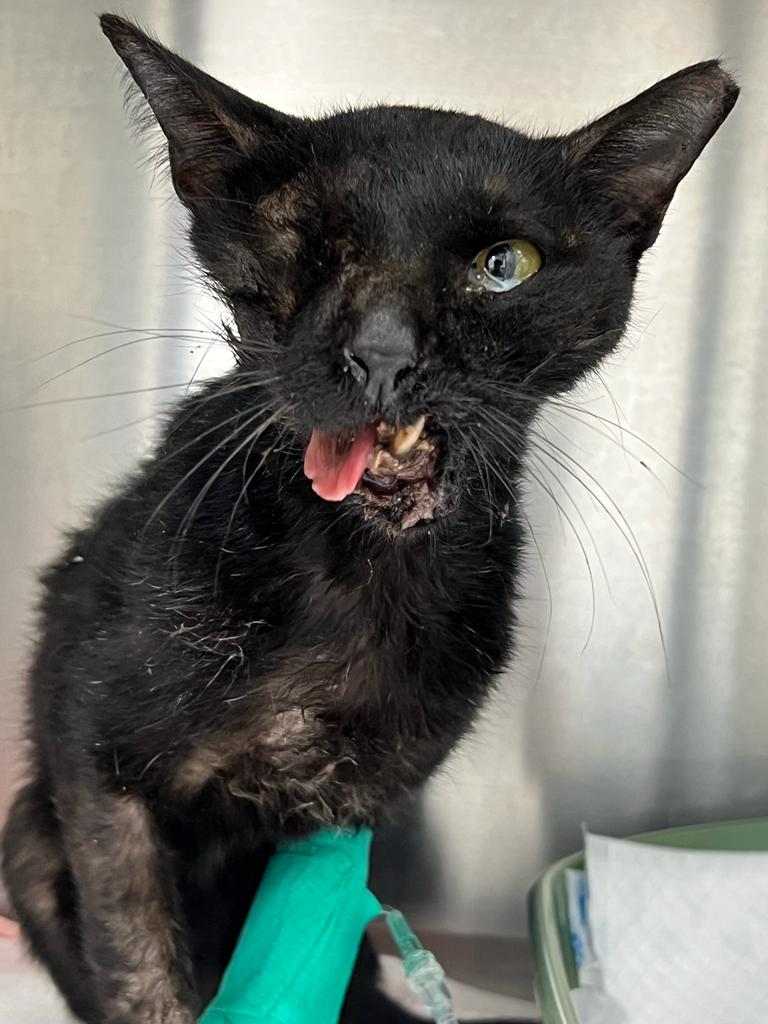
The cat had only one eye and its face on one side seemed sunken. On closer look, our volunteer noticed that part of the jaw appeared to be gone. The cat was drooling excessively and was emaciated. The cat, now named Inky due to his black coat, had been crying out non-stop and seemed exhausted, always trying to lean on the feeders for support and comfort. Inky was hungry, but food bits and saliva flung all over his face when he attempted to eat because of his jaw. He was affectionate and it was easy to secure him and put into a carrier. We are grateful that Inky knew he needed help and trusted us to give it to him.


There was a huge possibility that he had not eaten for weeks because of his broken jaw

At the vet

Inky has been warded at our vet. The initial prognosis was bleak because his jaw looked really bad, and we could not do an invasive examination given his weak state. He has a mass under his mouth, and both his mouth and eye were infected. There was inflammation and his kidney function was poor based on an X-ray and blood-test. He had to be syringe-fed. On his first night, basic treatment was adopted just to try and stabilize him - pain meds, antibiotics for infection and fluids for kidneys.


Inky's feeder found him on our Facebook page and visited him at the vet


After 8 hours, there were slight improvements. The nurses discovered Inky could swallow on his own, but food must be placed on his tongue as he could not pick up food on his own. He was also more comfortable, and allowed our vet to check his mouth more thoroughly. The good news is that the mandible jaw bone is still there, but had moved out of position. Nonetheless, we are still cautiously optimistic because he's an old cat with kidney failure.

Today he had a surgery to insert an esophagus feeding tube so that he can have more food and hence be able to absorb more nourishment and nutrients. This was done under anesthesia, and while he was on the table, the vet managed to X-ray his mouth and do a thorough examination. The vet has placed a wire on his jaw, to hold the jaw in place. This will remain for 6 to 8 weeks. 

We are still trying to figure out what happened to Inky. Did he meet with a traffic accident? If that were true, imagine the pain and fear. Through some divine intervention perhaps, someone who knew Inky saw our post on FB and got in touch with us. C is a dog owner who lives around 800m from where Inky was found. We believe this was the same cat he had been feeding since Dec 2022 at his apartment carpark. The same one-eyed, black cat with the long, skinny tail and tipped ear. Inky was a healthy weight then. Despite being a one-eyed cat, he enjoyed his food and his jaw was perfectly fine. According to C, he disappeared about a month ago and he thought he had found a better home. C was shocked and distraught to find out what really happened to Inky. It pains us to think that Inky might not have been able to eat and has been in pain for possibly as long as a month. How sad, and what a survivor he is.


Poor Inky's broken jaw :-( and we feel pain even with a small mouth ulcer


Inky has a microchip but is not registered with AVS. We are checking with SPCA if they have any records of his chip. We're hoping to find the person who chipped his so that we can know more about Inky and why his eye is gone. 

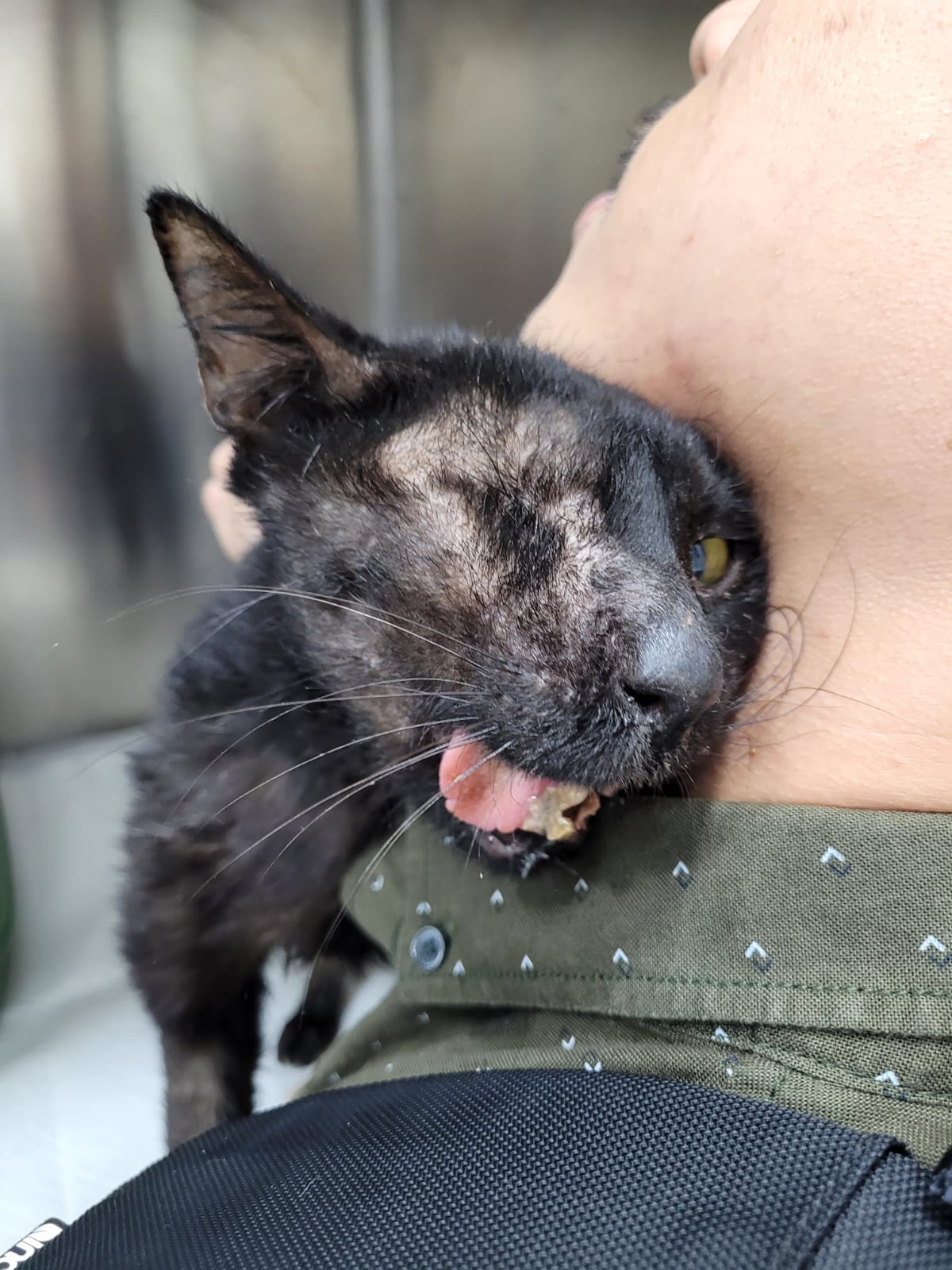
All the volunteers and nurses who have met Inky say he is a very sweet cat. We are all amazed by his resilience and fighting spirit despite the pain he is going through. We hope that he can find a good home in his golden years. 


Inky being tube fed and what an absolute darling he is <3 

Inky's story is a sad one, but definitely not an uncommon one for a stray animal. Strays wander about, never knowing when their next meal will come, or what it feels like to live a life of comfort and safety. If they are lucky, they meet kind people who take it upon themselves to check in on them periodically and feed them. But ultimately, they are still left to fend for themselves against all the dangers of the urban jungle that they find themselves living in. 

To date, sweet Inky’s vet bill is $5000. If you would like to help Inky with his vet bills, please email hopedogrescue@singnet.com.sg Thank you.

24.4.23

Stay Safe From Extreme Heat

Harper taking shade under an umbrella


Singapore is experiencing a heat spell right now so we hope that everyone is keeping well and cool! Just like us, dogs (and other animals) can also be affected by the heat. 

Heatstroke has always been a risk in our climate, but is an even bigger risk now given the current temperatures so it is important to recognize the signs of heatstroke in your dogs and how to treat it.

Heatstroke is the condition when the internal body temperature rises above a certain degree and usually occurs when high ambient temperature overcomes the body's ability to get rid of the excess heat. It is a very dangerous condition in dogs that can be fatal so it is crucial to recognize the early warning signs and treat them as soon as possible to try and bring the dog's temperature back to normal levels.


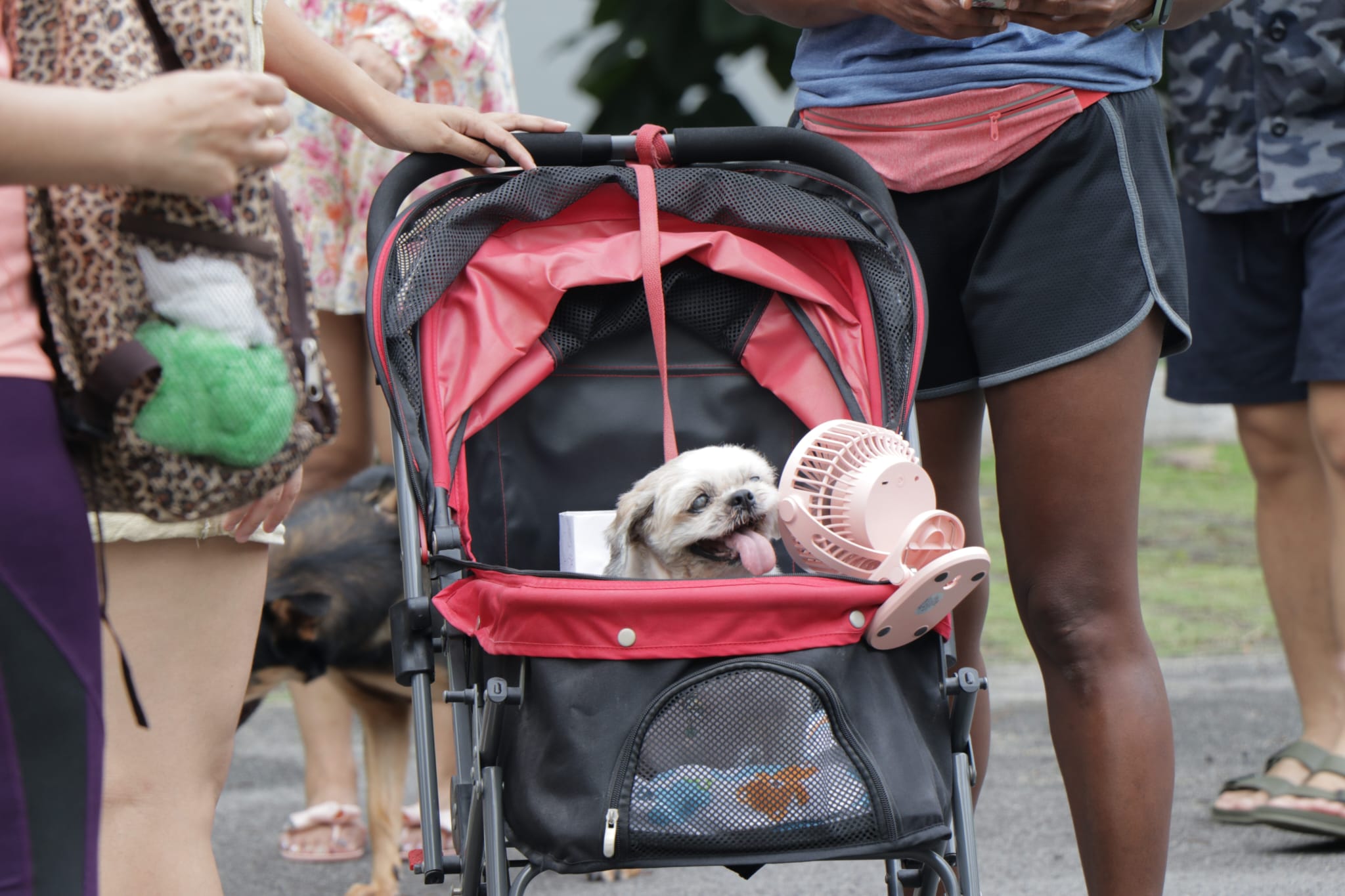
Chloe enjoying the breeze from her portable fan


Dogs pant to cool off, but if you notice your dog panting heavily and rapidly, then this may be a sign that heat stroke is starting to set in. This may be accompanied by excessive drooling. The gums and tongue may also appear bright red as the blood vessels dilate to try and dissipate the heat, and the tongue may also appear enlarged. The skin is hot to the touch and heart rate is increased at this point and the dog may have problems maintaining their balance. If nothing is done to try and reduce the dog's temperature, then the dog may start to exhibit signs of shock. They may experience muscle tremors, urinate or defecate uncontrollably, and even collapse and become comatose.


Olive resting during a walk 

Some dogs are more susceptible to heatstroke, such as dogs with thick fur, as well as the short-nosed breeds. If you suspect that your dog is showing the early signs of heatstroke, immediately take your dog to a cool and well-ventilated area. You can try to further lower the temperature of your dog by sponging them with cool, but not cold, water. Do not plunge them into a cold bath as the sudden drastic change in temperature is dangerous. 

Give your dog water but in small increments to prevent further dehydration. Take your dog to the vet immediately if they do not seem to be getting better after a few minutes as they may require fluids, oxygen and other medical support to regulate their vitals. 

As in most conditions, prevention is better than cure, and this is much more so for heatstroke as it is a completely preventable situation.


Zeus drinking water


Here are a few tips on how you can keep your dog cool and safe:

1) Walk your dogs earlier in the mornings before the heat has set in, or later in the evenings, after the ground has time to cool down. If you have to take your dogs out during the day, make sure to keep the walks short and try to stick to the grassy areas as concrete can get really heated and it is not only uncomfortable to walk on, but can actually cause burns on your dog's paws.

2) The home can also get hot during the day so make sure that while at home, there is lots of airflow and ventilation in the home and that your dog always has access to clean, cool water as dehydration is a real risk. 

3) Never, ever, leave your dog in a car without the aircon turned on. This is regardless of whether there is a heat spell or not as the interior of a car can quickly heat up.

Met Service has forecasted that the high temperatures are likely to carry on for the rest of April so we hope everyone and their pets stay cool and hydrated!